Ever Felt Strong but Stiff?
You’re not alone — many people train hard but still feel restricted or tight. True performance isn’t just about power; it’s about how well your muscles and fascia move together.
That’s where Fascial Stretch Therapy (FST) can take your training to the next level.
What Is FST?
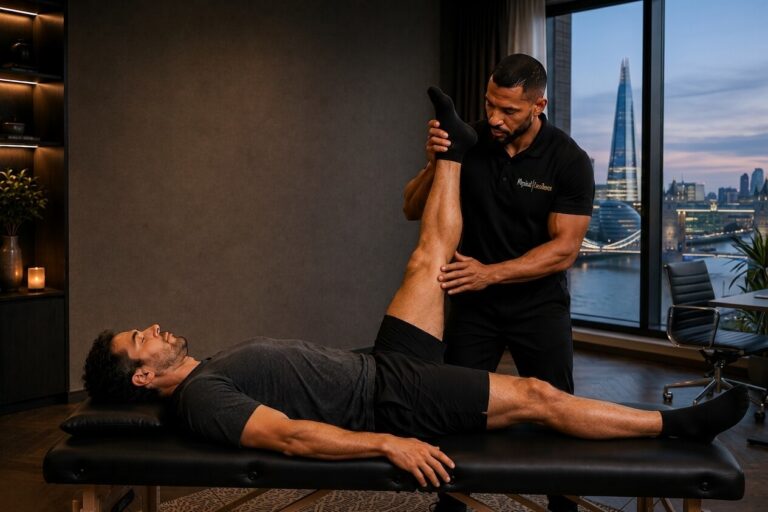
FST is an assisted stretching technique that targets the fascia — the connective tissue that links and supports your muscles and joints. When fascia becomes tight or dehydrated, it can limit movement, affect posture, and reduce strength output.
(You can learn more about the science of fascia in our blog: The Science of Stretch Therapy.)
Through gentle traction, decompression, and assisted stretching, FST helps restore balance, improve flexibility, and support better movement through your full range of motion.
👉 Research shows that fascia plays an active role in muscle coordination and recovery, not just structure (Wilke et al., 2018; Schleip & Müller, 2013).
Why Strength Training Alone Isn’t Enough
Strength training builds muscle and joint stability — but without mobility or recovery work, repetitive tension can build up in the fascia and surrounding tissues. Over time, this may lead to:
-
Restricted range of motion
-
Imbalances between muscle groups
-
Increased risk of injury
-
Slower recovery or training plateaus
If you’ve ever felt powerful but not fluid, FST can help unlock that restriction.
📚 Research indicates that fascia adapts to mechanical loading and may become stiffer when not adequately recovered (Zügel et al., 2018).
How FST Enhances Strength Training
When combined with resistance training, FST can significantly support performance and recovery:
-
🌀 Improved mobility: Freer joints allow better technique during lifts.
-
⚡ Enhanced muscle activation: Releasing fascial restriction enables more efficient muscle engagement.
-
💧 Faster recovery: Assisted stretching — a key element of FST — has been shown to increase blood flow and support recovery by improving vascular responses and reducing muscle soreness. These effects help the body recover more efficiently (Kruse & Scheuermann, 2017; Kruse et al., 2016; Behm & Chaouachi, 2011).
-
🧠 Greater body awareness: Stretching activates your nervous system for improved control under load.
While direct studies on FST are still emerging, findings from assisted and passive stretching research provide strong physiological support for its benefits.
At Physical Excellence, we integrate FST with strength training programmes to help clients move better, lift stronger, and recover faster.
“After adding FST into my routine, I noticed deeper squats, smoother lifts, and far less soreness — it’s like my body finally started working with me, not against me.”
— Client, Physical Excellence
The Smart Way to Combine Them
Think of FST as active recovery that complements your strength work:
-
Use dynamic stretches before training to prime movement.
-
Schedule FST sessions weekly to restore mobility and ease tension.
-
Include assisted stretches post-training or on rest days to speed up recovery.
Our clients often notice immediate differences — more fluid movement, better posture, and an overall sense of lightness in the body.
Final Thoughts
Strength builds you up. FST keeps you moving. Together, they create a powerful balance of strength, mobility, and longevity — helping you perform at your best while reducing the risk of stiffness or injury.
If you’re training hard but feeling restricted, try combining your next strength session with Fascial Stretch Therapy at Physical Excellence — your body will thank you for it.