You arrive somewhere — a hotel, a meeting, a family visit — and your body already feels wrecked. Stiff hips, an aching lower back, heavy legs, and a kind of fog that isn’t quite tiredness. You haven’t done anything yet, and you’re already moving like you’ve had a long day.
Most people write it off as “just travelling.” But what travel does to the body is quite specific, and once you understand it, most of it turns out to be avoidable.
It isn’t the distance — it’s the stillness
The single biggest reason travel leaves you stiff has nothing to do with how far you’ve gone. It’s how long you’ve been still.
Whether it’s a long-haul flight, a train, or hours behind the wheel, travel holds your body in one cramped position for far longer than it was ever built to stay put. Hips locked in a bend, spine fixed against a seat, legs still. Circulation slows, fluid settles into the lower legs and ankles, and the muscles and connective tissue gradually adapt to the shape you’ve held. (For the deeper mechanics of how sitting quietly reshapes the body, see what sitting does to the body.)
By the time you stand up, your body has spent hours rehearsing stillness — and it doesn’t switch back the moment you’re upright.
Everything else travel does at the same time
If it were only the sitting, a good walk on arrival would fix it. But travel rarely comes alone.
The cabin air on a flight is extremely dry, and mild dehydration makes tissue feel tighter and recovery slower. Sleep is broken or badly timed, and crossing time zones throws off the body’s natural rhythm, which is part of why everything feels heavier than the clock says it should. There’s the low-grade stress of the whole production — timings, security, connections — which quietly raises muscle tension throughout the body. And then there’s the physical part people forget: hauling, lifting and dragging luggage, often awkwardly and in a hurry.
None of these is dramatic on its own. Stacked together, in a single day, they add up to a body that feels stiff, heavy and strangely worn out before the trip has even begun.
Why it lingers once you’ve arrived
The frustrating part is that it doesn’t clear the moment you get where you’re going.
The body has adapted to the position you’ve spent hours in, and without something to reset it, that stiffness can shadow the first day or two — the meeting you’re not quite sharp for, the morning you wake up more rigid than you expected, the sightseeing that starts with creaky hips. For a short trip, that can be a meaningful slice of the whole thing spent below your best.
What actually helps
The good news is that travel stiffness responds well to simple, deliberate effort — before, during and after.
On the journey, move as much as the situation allows. Get up and walk the aisle, change position often, roll the ankles and shoulders, and drink more water than feels necessary. Small movements repeated often beat one big stretch at the end.
On arrival, resist the urge to collapse straight into a chair or bed. A short walk, some daylight and a little gentle movement do more to shake off a journey than an hour lying down. If you’ve crossed time zones, getting outside in natural light helps your body catch up faster.
And if you travel often, it’s worth treating your body’s recovery as part of the trip rather than an afterthought — because the same journey, taken by a body that’s already stiff and under-recovered, lands a good deal harder.
Where Assisted Stretch Therapy Fits
If travelling is something you do regularly, it makes sense to think about recovery as part of the journey rather than something that happens afterwards.
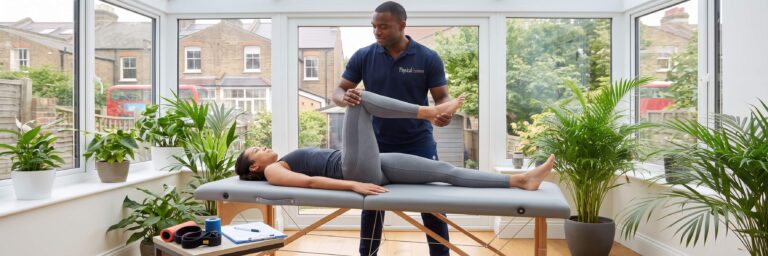
Some people find that Assisted Stretch Therapy provides a useful reset before travelling, helping them start the journey feeling freer and carrying less existing tension.
Others prefer it afterwards, as a structured way to move again after hours spent sitting, helping them feel more comfortable returning to work, meetings or sightseeing.
Because the service comes to you — including hotels across London — it fits naturally around travel without adding another journey when you’re already on the move. You can read more on the Assisted Stretch Therapy page.
The takeaway
Travel doesn’t wear your body out because you did too much. It wears it out because you did too little, for too long, in too small a space — with dehydration, poor sleep and stress layered on top.
Understand that, and the fix stops being mysterious. Move more on the way, reset on arrival, and give your body a little help when the trips are long or frequent. The journey will always take something out of you. It just doesn’t have to take as much as it usually does.
It isn’t the distance that stiffens you up. It’s the stillness.
If you’d like to explore how assisted stretch therapy could help you travel and arrive feeling better, I’d be happy to discuss whether it’s the right fit for you.
Ebou Njie Founder, Physical Excellence
Specialist Assisted Stretch Therapy & Private Training | London
This article is for general information only and should not be considered medical advice. Assisted Stretch Therapy is not a medical treatment. Individuals experiencing persistent pain or diagnosed medical conditions should seek advice from an appropriate healthcare professional.