For a lot of people, sitting is the most repeated thing they do all day — more than walking, more than standing, often more than sleeping. The body pays for that, but quietly. The stiffness when you first stand up, the back that aches by mid-afternoon, the energy that dips faster than it used to: most of it traces back to hours spent in a chair, and most of it builds so gradually you stop noticing.
I regularly see this pattern in clients across London, including Chelsea, Kensington, Knightsbridge, Mayfair and the City. Whether they work in finance, law, technology or another desk-based profession, many spend long hours sitting before wondering why their hips, back and shoulders never quite feel right.
It starts at the hips
Sitting holds the hips in a bent position for hours at a time. Many office workers spend six to eight hours or more sitting during a typical working day. Do that most of the day, most days of the week, and the body does what it always does — it adapts to the shape it’s held in most.
At the front of the hip, the flexors sit shortened the whole time you’re seated, and held there long enough they begin to settle at that shorter length, so the hip never fully opens even when you stand. At the back, the glutes spend the day switched off — lengthened, unused, dozing. The result is a hip that’s tight in front and asleep behind, which is exactly the combination that makes getting out of a chair feel stiff.
The connective tissue is part of this too. Growing research into fascia — the network that wraps and links muscle and joint throughout the body — points to how readily it reorganises around sustained posture. The seated shape isn’t just a habit your muscles fall into; over months and years it becomes the shape your body is built around.
Why it doesn’t stay in the hips
This is the part most people miss. Tight hips rarely stay a hip problem.
Shortened hip flexors tilt the pelvis forward, and the lower back arches to compensate — which is why so much desk-related back tightness actually starts at the hip. The dozing glutes leave the hamstrings and lower back to pick up work that isn’t theirs. Higher up, the chest and shoulders round forward toward a screen, the upper back stiffens, and breathing becomes a little shallower. None of these happen in isolation. The body works as one connected system, so a single sustained position spreads its effects in every direction.
After more than twenty years working with how people move, the pattern I see in desk-based clients is consistent — there’s rarely one thing to fix, but the trail almost always starts at the hips. Free those up and wake the glutes, and a lot of the tension stacked on top tends to ease with it.
The cost that adds up
On its own, a stiff hip or a tight back is a nuisance. Over time it can become more than that. A body that moves less freely tends to recover more slowly and hold tension it doesn’t really need to — and persistent discomfort is a quiet drain on attention. Most people don’t notice how much focus a nagging back has been taking until it eases.
The same pattern doesn’t stay personal. The link between prolonged sitting and musculoskeletal complaints — tight hips, lower back and neck discomfort — is well established, and across a team those small individual aches add up. It rarely shows up as one obvious problem. More often it’s a low, steady cost that workplaces absorb without ever putting a name to it.
Three things to notice
These quick checks may show you how far the seated shape has settled into your body. They take a few minutes.
- The stand-up check. After sitting for an hour or so, stand and try to stack fully tall over your hips without pushing your belly forward to get there. A pull at the front of the hip, or a back that won’t straighten without arching, points to shortened hip flexors.
- The knee-hug check. Lie on your back near the edge of a bed and hug one knee firmly to your chest. Watch the other leg. If that thigh lifts away from the surface rather than staying down, the hip flexor on that side has tightened.
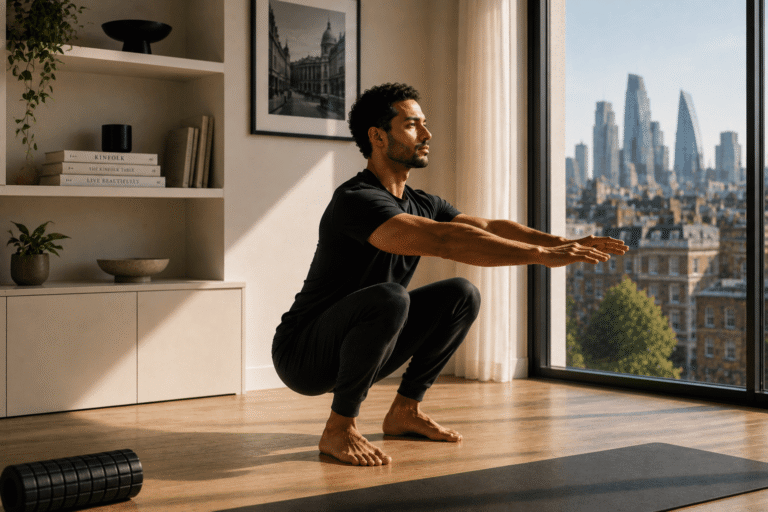
- The glute switch-on. Standing, try to squeeze one glute on its own, then the other. If one side is slow to fire or barely responds, that’s a glute switched off by sitting — and a back that’s probably covering for it.
Three things that may help
If those checks rang true, here are three gentle things to try. None should hurt — ease off if anything sharpens.
- Kneeling hip-flexor stretch. From a half-kneeling position (one knee down, the other foot forward), tuck your pelvis under slightly and shift your weight gently forward until you feel a stretch at the front of the kneeling hip. Hold 30–60 seconds each side. This lengthens the flexors that sitting shortens.
- Figure-4 stretch. Lie on your back and cross one ankle over the opposite knee to make a figure-4. Reach through and draw the supporting thigh gently towards you until you feel a stretch deep in the hip and glute of the crossed leg. Hold 30 seconds each side. This opens the deep hip rotators that a chair leaves tight.
- Glute bridge. Lie on your back, knees bent, feet flat. Press through your heels and lift your hips, squeezing the glutes at the top, then lower slowly. Repeat 8–10 times. This wakes the glutes so they share the load instead of leaving it to your back.
And the simplest of all: stand up every 30 to 45 minutes. Even a two-minute walk to refill your water bottle, visit a colleague or simply move around the office helps interrupt long periods of sitting. You can’t undo eight hours in a chair with one stretch at the end of the day, but regularly breaking up prolonged sitting helps stop those movement patterns becoming more established.
When self-help isn’t enough
These strategies can certainly help, but if you’ve spent years working at a desk, it’s common for these movement patterns to become well established. In many cases, the body needs more than stretches you can perform on your own.
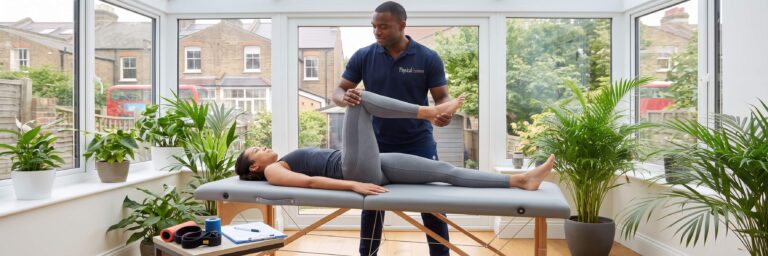
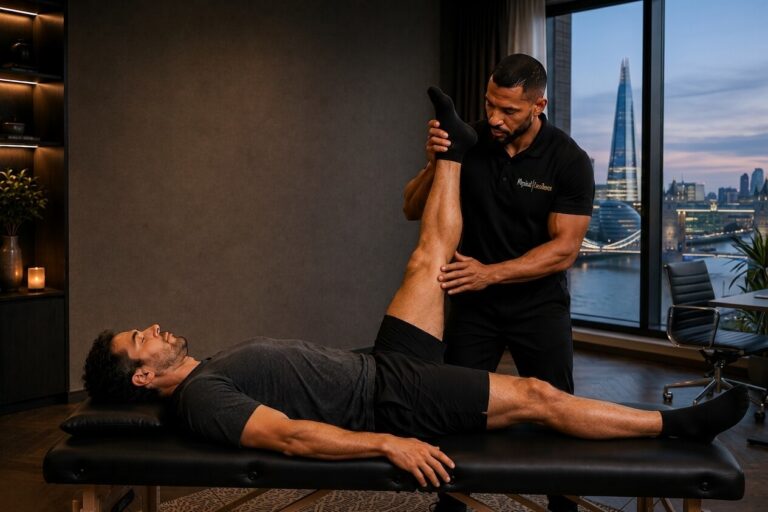
Assisted Stretch Therapy (Fascial Stretch Therapy, or FST) is a fully clothed, table-based treatment where your body is gently guided through controlled movements that help improve mobility, reduce accumulated tension and restore movement to areas that have gradually become restricted through prolonged sitting. The movements are comfortable, personalised and designed to work with your body rather than force it.
Whether you’re looking to move more freely, reduce day-to-day stiffness or simply feel less restricted after long hours at a desk, treatment is tailored to your individual needs.
For individuals, you can learn more on the Assisted Stretch Therapy page and book a complimentary consultation. For organisations, the same service can be delivered on-site, helping employees counteract the physical effects of prolonged desk work and supporting healthier, more comfortable movement throughout the working day.