Most people book their first assisted stretch therapy session with a version of the same question sitting in the back of their mind: what’s actually going to happen to my body for that hour? It’s a fair question. Nobody wants to turn up somewhere and just hope for the best.
So here’s the honest, practical answer — no jargon, no vague reassurances, just what actually takes place from the moment you book to the moment you leave.
Before we even start
Before we begin, you’ll be sent a short health questionnaire to complete ahead of the session — covering where you feel tight, whether you sit at a desk most of the day or are on your feet, any injuries old or recent, and anything that flares up when you travel or after a long week. It only takes a few minutes, and it means we’re not starting from scratch when I arrive.
This matters more than people expect. Two clients can both say “my shoulders are tight” and mean completely different things — one’s a desk-related postural issue, the other’s from years of a particular sport. The session needs to fit the person in front of me, not a generic template.
You stay fully clothed throughout — comfortable, stretchy clothing works best, similar to what you’d wear to train in. There’s no undressing, no oils, none of the things people sometimes associate with a treatment room. If you’ve never had assisted stretch therapy before, that’s usually the first thing that puts people at ease once I explain it.
What the session itself looks like
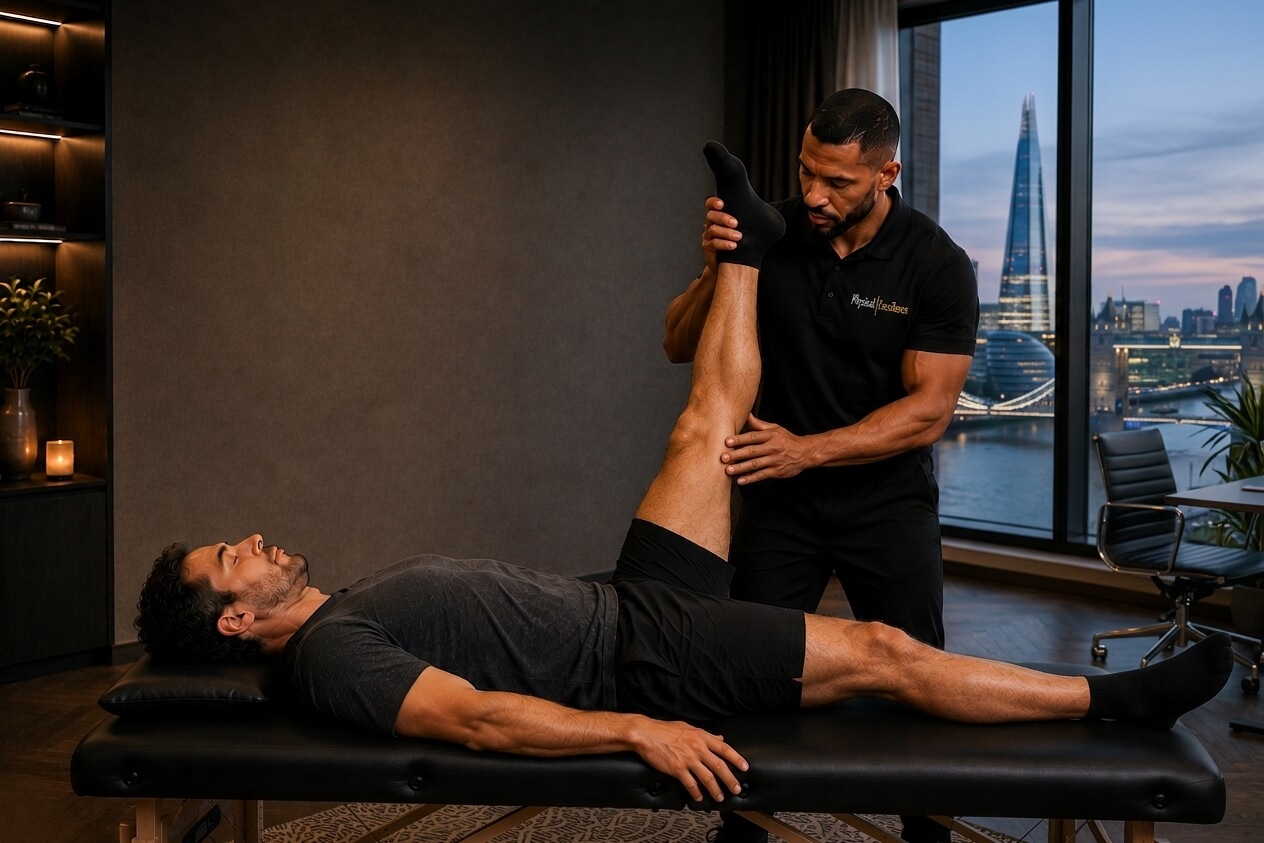
I use my hands and body weight to guide you through a series of stretches, moving your limbs through positions that are genuinely difficult to reach or relax into effectively on your own. That’s the entire point of “assisted” — a static stretch you do solo only takes you as far as your own strength and flexibility allow. With someone guiding the movement, you may be able to relax more fully and explore a comfortable range under controlled guidance.
The session shouldn’t be painful. Some positions feel intense, particularly if you’re carrying a lot of tightness somewhere specific, but you should never feel you have to endure pain or push through discomfort. I’m watching how you respond throughout — breathing, tension, how your body reacts to each position — and adjusting as we go. If something needs backing off, we back off. This isn’t a competition to see how far we can push.
A typical session runs through your major muscle groups — hips, hamstrings, shoulders, spine, depending on where you need the most work. Some sessions focus almost entirely on one area if that’s what’s causing you trouble. Others cover the whole body. We’ll talk about which makes sense for you before we start.
At the end of the session
We’ll briefly reassess how you feel and how comfortably you can move. I’ll explain what I noticed during the session and, where useful, suggest one or two simple movements you can use between appointments. If another session would be worthwhile, I’ll explain why — but there’s no pressure to commit to a package.
How it actually feels afterwards
Most people describe the same thing: looser, but also strangely more energised, not drained the way you might expect after physical work. That’s because the goal isn’t to exhaust muscles — it’s to release restriction and improve how well everything’s actually moving together.
Some people feel results immediately — a noticeable difference in how a shoulder rotates, or how easily they can bend to tie a shoe. For others, particularly if you’re dealing with tightness that’s built up over years, the change is more gradual and becomes clearer after a few sessions.
It’s worth being honest here: one session isn’t a cure-all. If you’ve had years of desk-bound stiffness or restriction that’s built up gradually, that took time to build, and it takes more than sixty minutes to fully unwind. After the first session, many people notice a difference in how freely or comfortably they move — but the response varies, particularly when tightness has developed over a long period, so don’t expect a complete transformation from one visit.
Why assisted stretching works differently to stretching on your own
Here’s the part most people never think about until it’s explained to them. When you stretch by yourself, you’re responsible for positioning yourself, stabilising your body and judging the intensity, all at the same time. That’s a lot to manage, and it can make it difficult to relax fully or reach certain positions comfortably.
During an assisted session, I control the position, pace and pressure, so you can focus purely on breathing and relaxing into the stretch. That division of labour, so to speak, is what makes it easier to explore a comfortable range of motion and target areas that are genuinely difficult to stretch effectively on your own. Guided stretching techniques are also used across sports therapy and rehabilitation settings, although assisted stretch therapy here is focused on mobility and flexibility rather than diagnosing or rehabilitating injuries.
Foam rolling, yoga and independent stretching can all be useful. Assisted stretching offers something different: you don’t have to manage the positioning and intensity alone, allowing you to concentrate on breathing and relaxing.
If you’re still on the fence
I hear the same handful of hesitations often enough that they’re worth addressing directly, rather than dancing around them.
I'm not flexible, so this probably isn't for me.
This is the single most common thing people say before their first session, and it’s almost always backwards. If you were already flexible, you wouldn’t need this nearly as much. The people who benefit most tend to be the least flexible walking in the door.
Will it hurt?
It shouldn’t. There’s a difference between intensity and pain. You’ll feel some positions working, particularly anywhere you’re carrying real tightness, but nothing crosses into pain. If it does, that’s on me to adjust, not something you need to push through.
I don't have time to travel somewhere for this.
You don’t have to. That’s genuinely the entire point of how I’ve built this — I come to you.
What if I don't know what I need?
That’s fine, and honestly the norm. Most people can point to where they feel tight, but they don’t need to diagnose anything themselves. That’s what the conversation at the start of the session is for.
Where it happens
Sessions take place at your home, your office, or wherever’s most convenient — that’s the whole model. I bring everything needed: the treatment table, all the equipment, nothing for you to arrange. No commuting to a studio, no changing rooms, no fitting a session around someone else’s opening hours. I work across London, from private homes to corporate offices, and the session runs exactly the same wherever it happens.
Who it’s actually for
I get asked this a lot, so let me be direct: you don’t need to be an athlete, and you don’t need to already be flexible. In fact, the people who benefit most are often the opposite — people who’ve never really stretched properly in their life, professionals who sit for ten hours a day, people who remain stiff or restricted following a previous injury (once appropriately assessed or cleared to exercise), or anyone whose body just doesn’t move the way it used to.
If you’re dealing with a specific medical condition, tell me before booking, and I’ll let you know honestly whether this is right for you or whether you’d be better served by something else first. I’d rather be upfront about that than take a client on and have it not actually help.
What to expect right after you book
You’ll get a quick confirmation with the time and what to wear, along with the health questionnaire to complete beforehand — that’s the only thing to do before I arrive. Just show up ready to move, and we’ll take it from there together.
A few quick questions people ask before booking
How long does a session run?
Sixty minutes is standard, though some clients prefer ninety, particularly for a first session or if we’re covering the full body rather than one specific area.
Do I need to do anything to prepare?
Just complete the short health questionnaire sent with your booking confirmation, and wear something you can move in comfortably. No fasting, no special routine beyond that.
How many sessions will I need?
Depends entirely on what you’re dealing with. Some clients come in for a one-off before a big trip or event. Others build it into a regular routine, similar to how people treat a monthly massage, because the benefits compound over time rather than resetting to zero between visits. I’ll give you an honest read on what makes sense for you after the first session, not a sales pitch.
Is this the same as a sports massage?
No, and it’s worth understanding the difference. Massage generally uses hands-on pressure and manipulation of the soft tissue. Assisted stretch therapy uses guided movement and controlled stretching to work on mobility, flexibility and comfortable range of motion. They’re different approaches, and for a lot of people, complementary rather than either-or.
Ready to feel the difference for yourself? [Book your first assisted stretch therapy session] with Physical Excellence, delivered to your home or office across selected areas of London.