On paper, working from home should be kinder to your body. No commute. No crowded train. Your own space, your own kettle, the freedom to move whenever you like.
So it catches a lot of people by surprise when the opposite happens — when the stiffness, the aching back, the tight neck and the end-of-day heaviness turn out to be worse at home than they ever were at the office.
It isn’t in your head, and it isn’t because home is somehow bad for you. It’s because of three quiet things that change the moment your office becomes a spare room, a kitchen table or the corner of a sofa.
You didn’t lose the commute — you lost the movement inside it
The commute is easy to celebrate losing. But hidden inside that daily grind was a surprising amount of movement, and you got it without ever deciding to.
Walking to the station. Climbing the stairs. Crossing the office to a meeting room. Standing at the kettle chatting to a colleague. Popping out for lunch or a coffee. None of it felt like exercise, which is exactly why it worked — it was movement scattered through the day without any effort or intention on your part.
At home, most of that simply vanishes. It’s entirely possible to complete a full working day in a few dozen steps: bed, desk, kettle, sofa, bed. The office kept you moving without you noticing. Home lets you sit still without you noticing. That’s the single biggest change, and it’s the one nobody plans for.
Your setup is probably improvising
Offices are far from perfect, but most at least give you a desk at roughly the right height, a chair designed for the job, and a screen at eye level.
Home rarely does. People work hunched over a laptop at the kitchen table, curled into a sofa, perched on a bed, or at a desk that was never designed for eight hours of work. The body adapts to the positions we spend the most time in, and long periods in these setups can leave the shoulders, neck, back and hips feeling increasingly stiff and restricted. (For the mechanics of how sitting influences the body, see What Sitting Does to the Body.)
The day loses its edges
An office day has natural punctuation built in. You arrive, you leave, you walk to meetings, you break for lunch, you’re interrupted. Those pauses matter more than they seem — each one is a small chance to stand, shift and reset.
At home, the edges blur. Video calls run back to back with no walk in between. Lunch happens at the desk, if it happens at all. The start and finish of the day drift, and the working stretch gets longer. So the body is held in one position, for longer, with fewer natural breaks than an office ever allowed — and tension accumulates in exactly the places you’d expect: the hips, the lower back, the neck and shoulders.
What actually helps
The fix isn’t to recreate the office. It’s to deliberately rebuild the movement the office used to hand you for free.
The simplest and most effective habit is to bookend your day with a short walk — a “fake commute.” Ten minutes out of the door before you start and again when you finish gives your body the movement and the mental full-stop that working from home quietly removed.
Beyond that: stand up every thirty to forty-five minutes, even briefly. Take audio-only calls on your feet or walking. Move your setup toward a proper chair and a screen at eye level if you possibly can. And build in the odd genuine pause — the body copes far better with sitting when sitting isn’t unbroken.
Where Assisted Stretch Therapy Fits
If stiffness has already become part of your daily routine, rebuilding healthier movement habits is still the most important long-term solution.
Some people, however, also benefit from more focused mobility work alongside those changes.
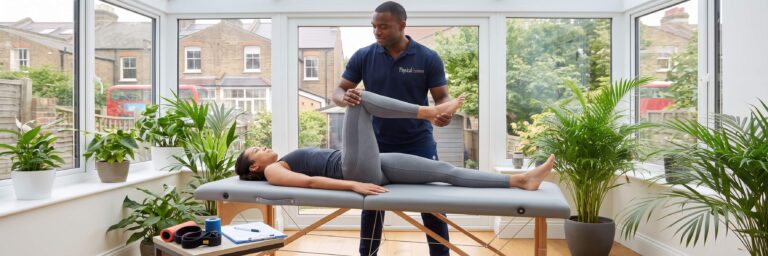
Assisted Stretch Therapy can provide a structured opportunity to move through ranges that may have become less comfortable after months of working from home, helping to complement — not replace — the everyday habits that keep your body moving well.
And because you’re already at home, the session fits naturally into your day without adding another journey across London. You can read more on the Assisted Stretch Therapy page.
The Takeaway
Working from home isn’t the problem. The quiet loss of everyday movement is.
The office used to build movement naturally into your day. At home, that responsibility becomes yours.
- A short walk before work.
- Standing up more often.
- Taking regular breaks.
- Creating a better workspace.
Small habits like these can make a remarkable difference over time. When you deliberately put some of that lost movement back into your day, the stiffness that often comes with home working becomes far more manageable.
You didn’t just lose the commute — you lost the movement hidden inside it.
If you’d like to explore how assisted stretch therapy could fit around a home-working day, I’d be happy to discuss whether it’s the right fit for you.
Ebou Njie Founder, Physical Excellence
Specialist Assisted Stretch Therapy & Private Training | London
This article is for general information only and should not be considered medical advice. Assisted Stretch Therapy is not a medical treatment. Individuals experiencing persistent pain or diagnosed medical conditions should seek advice from an appropriate healthcare professional.