When you are responsible for researching employee wellbeing options, one of the first questions is practical: what will employees actually experience, and how much organisation will it require from your team?
An on-site assisted stretch therapy day gives employees private, one-to-one appointments during the working day. I bring the treatment table and all the equipment to your workplace, manage each session individually, and work around whatever schedule and space you’ve got — there’s nothing for your team to set up.
Here is what the process looks like, from the initial enquiry through to the day itself.
What an on-site assisted stretch therapy day involves
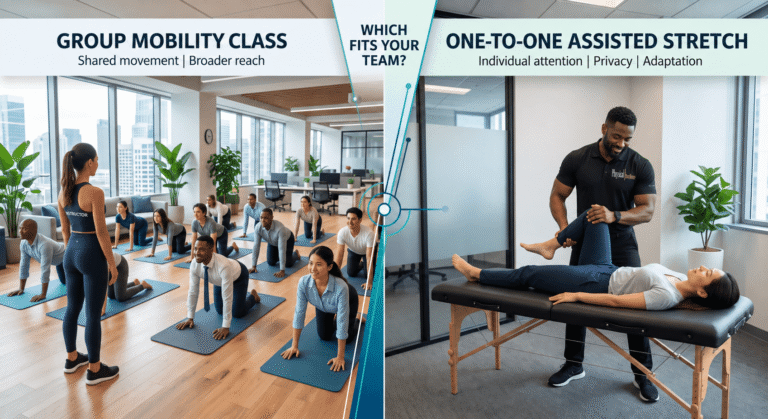
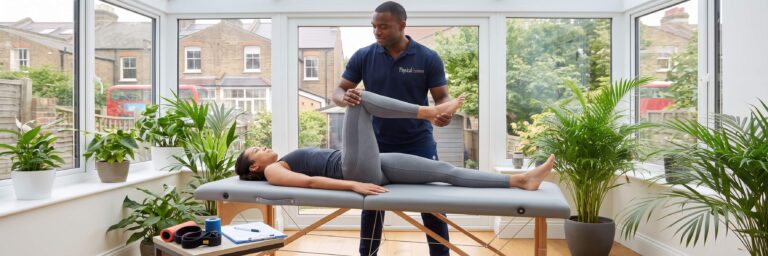
Each employee receives an individual assisted stretching session rather than taking part in a group class or demonstration. Sessions are delivered in a private meeting room, wellness room or another suitable enclosed space within the workplace.
Using guided movement and controlled stretching, I work with the employee on areas where they feel stiff or restricted. For desk-based teams, common areas include the neck, shoulders, upper back, hips and legs, although every session is adapted to the person rather than following one routine for everyone.
Employees remain fully clothed throughout. Comfortable clothing that allows easy movement is ideal, but there is no need for sportswear, oils or shower facilities.
How the day is planned
I run these as a half-day, a full day, or an ongoing monthly retainer for teams that want it as a regular benefit rather than a one-off — depending on team size, available time, and appointment length.
Individual sessions usually last between 30 and 45 minutes for a workplace wellbeing day. Shorter appointments allow more employees to participate, while longer appointments provide more time to address several areas in greater depth.
There are two straightforward ways to manage the schedule:
- The organisation can allocate appointments to selected employees.
- Available appointments can be opened to the wider team and booked on a first-come, first-served basis.
The second option often works well for larger teams because employees can choose a time around meetings and other responsibilities. For a smaller department or leadership team, pre-assigned appointments may be simpler.
Before confirming the format, I’ll ask a few practical questions — roughly how many people, what hours you’ve got available, and what kind of room you can offer. The schedule gets built around your working day, not the other way round.
Health screening and employee confidentiality
Every participant completes a short health questionnaire before their appointment. This covers relevant injuries, medical conditions, current symptoms and anything else that may require the session to be adapted.
That information is submitted directly to me and handled confidentially. Your organisation doesn’t see anyone’s individual medical details — that stays between me and the employee.
If assisted stretching isn’t appropriate for someone, or medical clearance would be sensible first, I’ll explain that to them privately rather than trying to work around it on the treatment table. That’s not a formality — it’s how the whole thing stays professional and safe to run.
What employees experience during their appointment
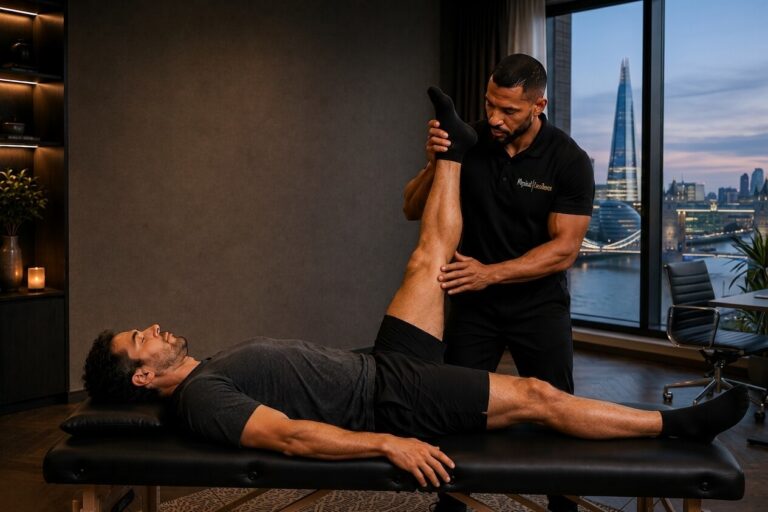
At the beginning of each session, I have a brief conversation with the employee about how they feel and which areas they would most like to address. I then guide them through a series of assisted stretches, controlling the position, pace and intensity throughout.
The session should not be painful. Some stretches may feel strong, particularly around an area carrying a lot of tension, but employees are not expected to push through pain or compete to reach a particular position.
Once the appointment is complete, the employee can return directly to their working day. Many people report feeling looser, more relaxed or more comfortable afterwards, although responses naturally vary from person to person.
What a typical full day looks like
I normally arrive approximately 30 minutes before the first appointment. This provides time to set up the treatment table, check the room and make sure everything is ready without involving the office or facilities team in the physical setup.
Appointments then run according to the agreed schedule through the morning and afternoon. A brief transition is included between employees so the treatment table and equipment can be sanitised and reset before the next person arrives.
Depending on the length of the working-day window and the transition time between appointments, a full day can typically accommodate approximately 10 to 12 focused 30-minute sessions. Fewer employees can be seen when 45-minute appointments are chosen.
A break is built into longer bookings, which also gives the schedule some flexibility if an employee is briefly delayed by a meeting. At the end of the day, I pack away the table and equipment and leave the room as it was found.
Why the on-site format works well
The biggest advantage is convenience, and it’s a real one, not a soft claim. Employees don’t need to travel to a studio, attend something after work, or reorganise their evening around an external appointment. The service comes to them, inside a slot that’s already part of their working day.
The one-to-one format also means the session adapts to whoever’s on the table. One employee might be dealing with shoulder tension from months at a screen, another with hip restriction from constant travel. They don’t have to follow the same movements just because they work for the same company — that’s the whole point of individual sessions over a group class.
From your side, what’s actually needed is minimal:
- A suitable private room
- An agreed appointment schedule
- Letting employees know how to book their slot
I bring the treatment table, equipment, and health screening — you don’t need to arrange any of it.
How it complements existing employee benefits
Assisted stretch therapy does not need to replace gym memberships, mental wellbeing resources, group exercise or other benefits already available. It addresses a different part of the employee experience: physical stiffness and restricted movement associated with desk-based work, commuting, travel and long periods of sitting.
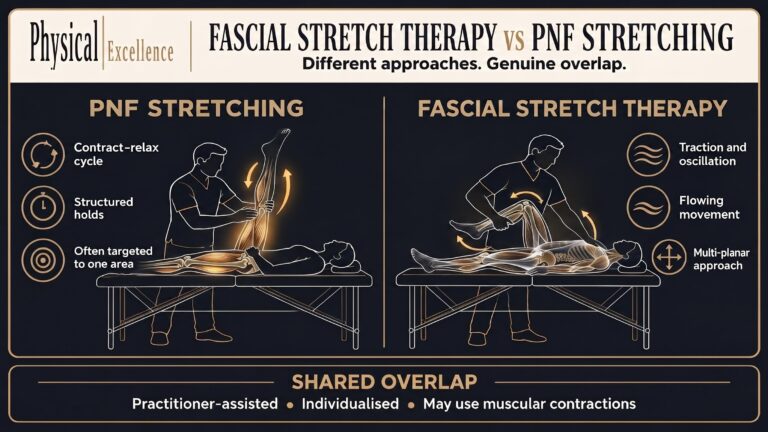
Massage is one of the closest workplace comparisons, but the approaches are different. Massage generally uses hands-on pressure and manipulation of the soft tissues. Assisted stretch therapy uses guided movement and controlled stretching with a focus on mobility, flexibility and comfortable range of motion. The two approaches can complement one another within a broader wellbeing programme.
It is also important to be realistic about what one wellbeing day can achieve. A single appointment will not resolve every longstanding postural or musculoskeletal concern. It can, however, give employees an individual physical wellbeing experience without requiring them to leave the workplace or enrol in an ongoing programme.
Which organisations is it suitable for?
On-site assisted stretch therapy is particularly relevant to desk-based teams in sectors such as finance, law, technology and professional services. It can also be useful for employees who travel frequently or spend extended periods working at a screen.
The service can be used in several ways:
- A standalone employee wellbeing day
- Part of a wider wellbeing week
- An introductory pilot before considering a regular service
- A quarterly or monthly employee benefit
- A smaller session for a particular department or leadership team
The right format depends on the organisation’s objectives, headcount, available space and budget.
Pricing and booking
I offer a complimentary half-day pilot for organisations weighing this up — no cost, no commitment, just a proper chance for your team to experience it before deciding on anything further. Most companies that run a pilot move on to an ongoing arrangement afterwards, usually a monthly retainer, since that’s where this tends to deliver the most value over time. A one-off half or full day is also available if a single event is all you need.
After confirming your approximate headcount, preferred session length, and available hours, I’ll recommend the most suitable format and provide a clear quotation.
Questions HR and facilities teams often ask
Do you need a specialist treatment room?
No. A quiet, private meeting room, wellness room or suitable enclosed space with enough room for a treatment table is usually sufficient. I’ll confirm the space requirements before the booking.
Does the employer need to provide equipment?
No. I bring the treatment table and all equipment required for the sessions.
What should employees wear?
Comfortable clothing that allows movement is best. Employees remain fully clothed, and there is no need to change into specialist sportswear.
What happens if someone has an injury or medical condition?
Each employee completes a confidential health questionnaire beforehand. The session can be adapted where appropriate, and I’ll advise the employee privately if assisted stretching is unsuitable or medical clearance should be obtained first.
Can the service be recurring rather than a one-off?
Yes — and for most organisations, that’s actually where this lands. A one-off day works well for a single event, but once a team’s been through the pilot, a monthly retainer is the more common next step.
How disruptive is the setup?
Very little is required from the employer beyond providing the room and helping employees access the appointment schedule. I arrive early, set everything up, deliver the sessions and pack everything away afterwards.
If you’re considering assisted stretch therapy for your employees, I’d be happy to talk through a practical format based on your team size, workplace and available hours — starting with a complimentary pilot if that’s useful.