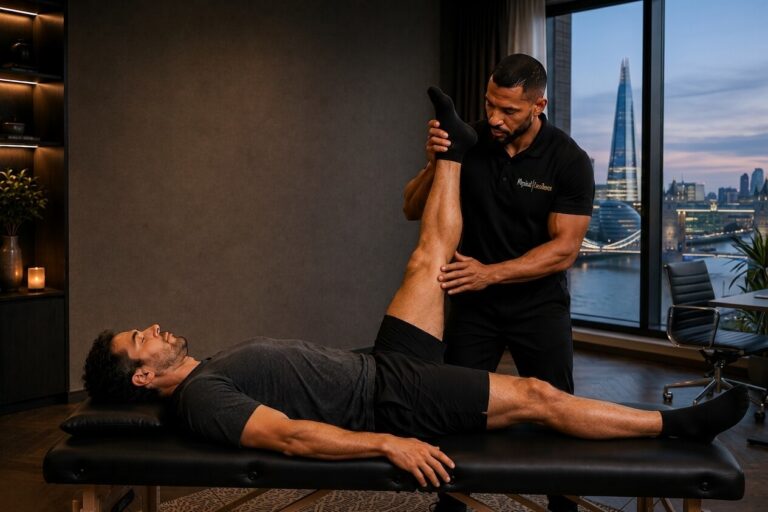
Most people think of stretching as something you do quickly before or after exercise. But stretch therapy is a structured, science-backed practice that goes much deeper. It doesn’t just loosen muscles — it works with fascia, the nervous system, and circulation.
And the best part? It’s suitable for everyone — no matter your age, lifestyle, or fitness level.
What Is Stretch Therapy?
Stretch therapy is a guided method of assisted stretching. A therapist uses gentle traction, specific holds, and movement patterns to release tension and restore mobility.
It’s suitable for everyone — regardless of age, activity level, or lifestyle. Whether you’re an office worker, a parent, an athlete, or simply someone who feels stiff, stretch therapy can be adapted to your needs.
Fascia: The Hidden Web in Your Body
Fascia is the connective tissue that wraps around muscles, joints, and organs. When healthy, it’s flexible and smooth. But inactivity, stress, or poor posture can cause it to stiffen, limiting movement and even leading to pain.
 Science Spotlight: Modern research highlights fascia as an active, sensory-rich tissue that plays a direct role in movement and pain perception (Wilke et al., 2018).
By targeting fascia, stretch therapy helps restore elasticity, reduce tension, and allow freer, easier movement.
Nervous System Reset: Why It Feels So Relaxing
Stretch therapy doesn’t just target muscles — it also works with your nervous system.
Inside your muscles are tiny sensors that tell your brain whether a stretch is safe. Assisted stretching activates these sensors, which helps your nervous system “reset,” allowing muscles to relax instead of resisting.
In simple terms: stretch therapy teaches your body it’s safe to let go, which is why sessions feel both physically freeing and mentally calming.
Research in sports medicine shows fascia and connective tissue adapt to stretching and can influence the nervous system’s response to movement and stress (Zügel et al., 2018).
Improved Circulation and Recovery
Stretch therapy also supports blood flow and tissue recovery. Gentle, sustained stretches can increase circulation within fascia and muscle tissue, helping to:
- Deliver oxygen and nutrients
- Remove metabolic waste
- Support post-exercise recovery
Research shows that stretching can temporarily alter fascial tension and influence fluid exchange in connective tissues, supporting recovery and mobility (Schleip et al., 2012).
Everyday Benefits
Stretch therapy supports your daily life by helping you:
- Relieve stiffness and tension
- Improve posture and balance
- Reduce stress and feel calmer
- Recover faster after activity
- Stay mobile and confident as you age
These are benefits that anyone — from students to professionals to older adults — can experience.
Stretch Therapy vs. Regular Stretching
- Regular stretching: Self-guided, often inconsistent, mostly muscle-focused.
- Stretch therapy: Assisted, targeted, fascia-focused, and tailored to your body.
Think of it as the difference between trimming your own fringe and visiting a professional stylist — both help, but one delivers far better results.
Where to Try Stretch Therapy in London
At Physical Excellence, we offer personalised stretch therapy sessions in London. Whether you want to move better, recover faster, or simply unwind, our approach blends science with hands-on techniques for lasting results.
 Book your first session today and feel the difference in your body.
Conclusion: More Than Just a Stretch
The science is clear — stretch therapy improves fascia health, calms the nervous system, and supports circulation. It’s not just about flexibility; it’s about moving, feeling, and living better.
And because it’s suitable for everyone — from busy parents to older adults to athletes — stretch therapy could be the missing link in your health and well-being routine.
References
- Wilke, J., et al. (2018). Not merely a protective packing organ? A review of fascia and its force transmission capacity. PubMed: https://pubmed.ncbi.nlm.nih.gov/29122963/
- Zügel, M., et al. (2018). Fascial tissue research in sports medicine: from molecules to tissue adaptation, injury and diagnostics. PubMed: https://pubmed.ncbi.nlm.nih.gov/30072398/
- Schleip, R., & Müller, D. G. (2013). Training principles for fascial connective tissues: Scientific foundation and suggested practical applications. PubMed: https://pubmed.ncbi.nlm.nih.gov/23294691/
- Schleip, R., et al. (2012). Strain hardening of fascia: static stretching of dense fibrous connective tissues can induce a temporary stiffness increase. PubMed: https://pubmed.ncbi.nlm.nih.gov/22196433/