Your working week can look perfectly organised on a calendar and feel completely different in your body.
Monday at home. Tuesday crossing London between meetings. Wednesday a bit of both. By Friday you feel stiff, tired or slightly restricted, and it is hard to say which part of the week did it.
That is true whether you work in finance, run a team or lead an HR department. Everyone who works has a working week. That is why hybrid working and physical wellbeing need to be looked at across the whole week: your body experiences all of it, not just one desk, one posture or one day.
This article gives you a simple way to see your own week more clearly. If you are also responsible for other people’s wellbeing, it ends with how the same idea scales across a whole organisation.
Why every working day feels different
An office day may contain more walking, but it can also involve long meetings and less control over when you change position.
A home-working day may offer more freedom, yet fewer natural reasons to get up. There is no walk to the station, no journey between meeting rooms and sometimes no gap between one call and the next.
Other days might include client visits, different workstations, driving or carrying equipment between locations.
None of these is automatically better or worse. The real question is how much physical variety each day contains, and how you respond to it.
The Health and Safety Executive’s guidance on display screen equipment applies to people working at home as well as in the office. It recommends regular breaks or changes of activity so people can move and vary their posture.
That is a useful foundation. But it cannot tell you which part of your own week affects you most. Observing the complete week can help make that clearer.
The Working-Week Body Map
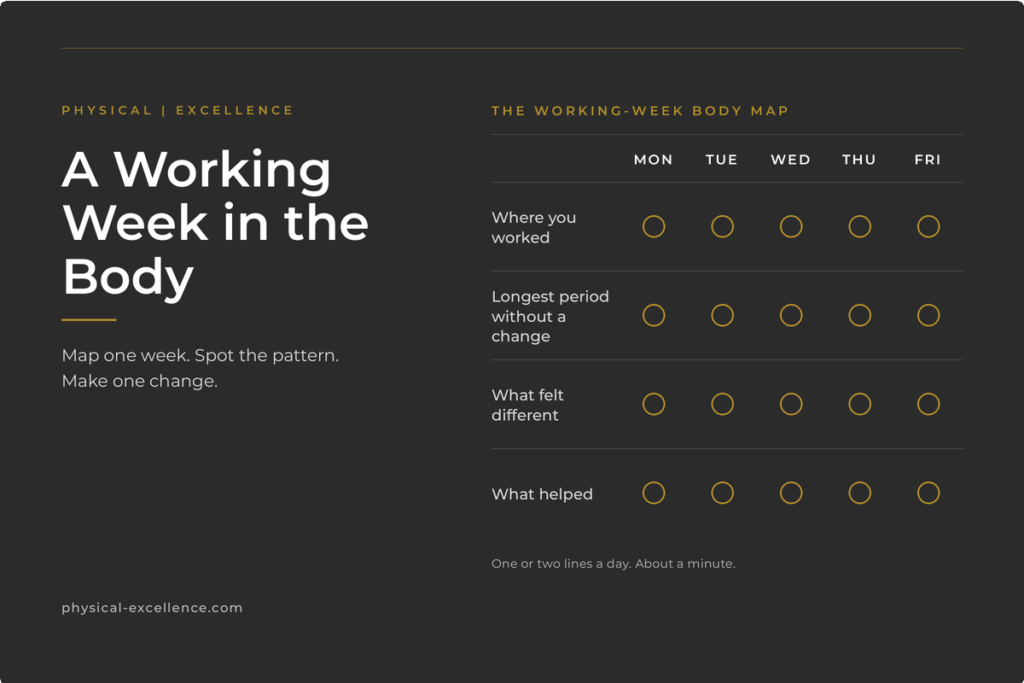
Try observing one complete working week. It takes about a minute a day.
This is not a medical assessment, and you do not need an app or a wearable. At the end of each working day, note four things:
- Where you worked. At home, in the office, travelling or across several locations.
- Your longest period without changing activity. A block of meetings, focused desk work, driving or travelling.
- What felt different by the end of the day. Perhaps standing tall felt less comfortable, turning your neck felt different, or you simply felt more tired than you did that morning.
- What helped. Walking, training, changing position, taking a break, or nothing in particular.
One or two lines a day is enough. The point is to compare days, rather than relying on how you happen to feel at one moment.
What your week may reveal
By Friday, a pattern may start to appear.
You might find you feel better after an office day because the commute naturally includes more walking. Working from home may be comfortable until several video calls run back to back.
Travel days might affect you more than desk days. Or the first change might show up earlier in the week than you realised.
Some people find no obvious work-related pattern at all. Training, sleep, previous injuries and life outside work all play a part too.
The value is not in blaming one activity. It is in replacing a vague feeling, “I always feel stiff by Friday”, with a clearer picture of when the change starts and what seems to influence it.
Choose one change for next week
Once you have spotted a pattern, choose one realistic change.
- If home days have the least movement, a short walk before work or at lunchtime can restore some structure.
- If back-to-back meetings are the issue, standing or moving briefly between suitable calls can break up the day.
- If travel takes the most out of you, rethinking what you carry, or moving a little after the journey, may matter more than another general stretching routine.
Match the change to the pattern you actually saw. One change you can repeat beats an ideal routine that lasts three days.
Now picture fifty different weeks
You have just mapped one working week: your own. Now imagine everyone in your organisation doing the same.
Very few maps would look exactly the same. One person’s hardest day is a home day full of video calls. Another’s is a Tuesday spent travelling across London. A third feels fine all week and stiffens only after a quarter-end deadline.
This is what makes hybrid worker wellbeing harder than it first looks. People can share a workplace without sharing a working pattern.
If you work in HR, People or Workplace, your own Body Map is a useful starting point. You already know what it is like to sit through back-to-back calls. Before introducing any physical-wellbeing initiative, it is worth asking:
Which parts of the working week give our employees the least opportunity to move, change activity or recover?
That question often reveals more than asking whether people would like another wellbeing benefit. It can shape which days support is offered, whether one-to-one or group formats suit your people better (see one-to-one stretch sessions vs group mobility classes), and how easily employees can take part without disrupting their work.
Sharing the Body Map with your team. You are welcome to share this exercise with employees as a simple, voluntary idea. Keep it private: the notes belong to the individual, not the organisation. If you want a wider picture, ask one anonymous question instead, such as “Which day of your working week leaves you feeling most physically drained?”
Where workplace Assisted Stretch Therapy fits
Workplace Assisted Stretch Therapy in London is one way organisations can offer individual physical-wellbeing support during the working day.
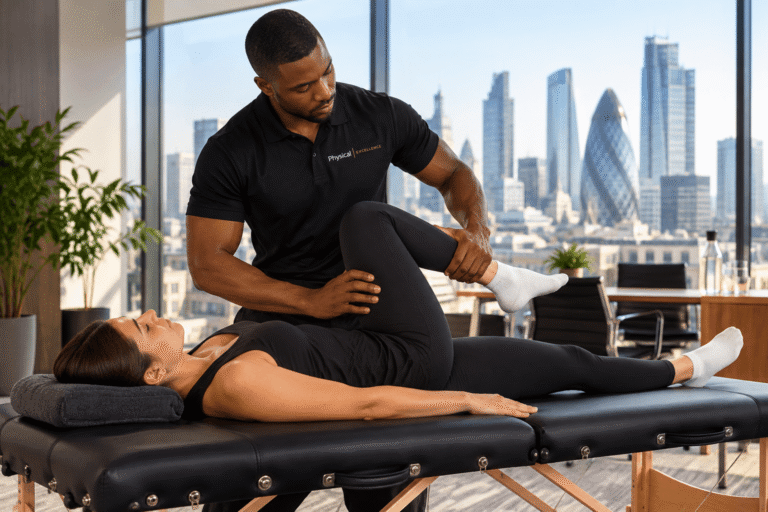
Sessions are 30 minutes, one-to-one, private and voluntary. Employees stay fully clothed and are guided through assisted movements on a treatment table. Sessions are delivered on-site across London.
Because each session is individual, it can respond to how that person moves, rather than giving everyone the same routine. You can read more about Assisted Stretch Therapy and how it works.
If you are weighing up providers, the HR checklist for workplace Assisted Stretch Therapy covers the practical questions to ask, and what an on-site employee wellbeing day looks like shows how a day runs.
Assisted Stretch Therapy is not a replacement for regular movement, strength training, a suitable workstation or medical care when needed. It is one part of a broader approach to employee physical wellbeing.
Look at the week, not only the symptom
It is easy to notice how your body feels at the end of a demanding week. It is harder to see where the pattern began.
For you, the Working-Week Body Map can point to one useful change to test. For an organisation, it offers a clearer view of how different working patterns affect the people behind them.
A working week is not five repetitions of the same day. Your body does not treat it as one, and neither should wellbeing support.
For organisations considering individual physical-wellbeing support, a complimentary half-day pilot can show how one-to-one sessions fit around the reality of the working week. I’d be happy to discuss.
Ebou Njie Founder, Physical Excellence
Specialist Assisted Stretch Therapy & Private Training | London
This article is for general information only and isn’t medical advice. Anyone with an injury, medical condition or pregnancy should speak to a GP or qualified healthcare professional before starting any new physical therapy.