Bringing a new wellbeing service into the workplace shouldn’t create more work for HR.
For organisations considering workplace assisted stretch therapy in London, the priorities are simple: professional delivery, employee comfort, minimal disruption and a service that’s straightforward to organise.
Here are eight things HR and People teams should consider when choosing a provider.
1. Who will deliver the sessions?
With a one-to-one, hands-on service, it’s worth knowing who will actually be coming into your workplace.
Ask about the practitioner’s qualifications, experience and whether the same practitioner will usually deliver future visits.
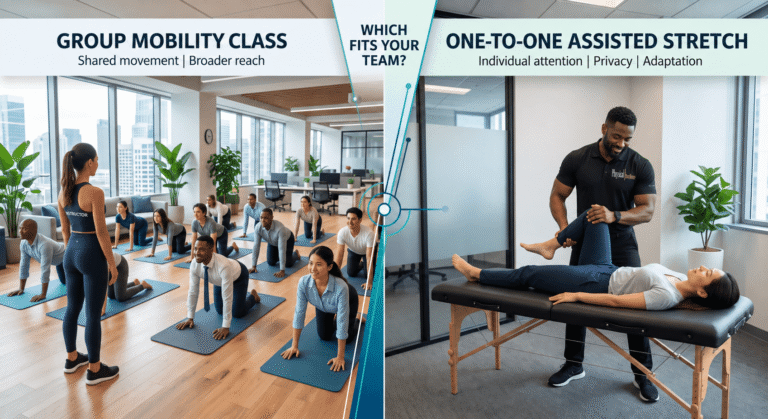
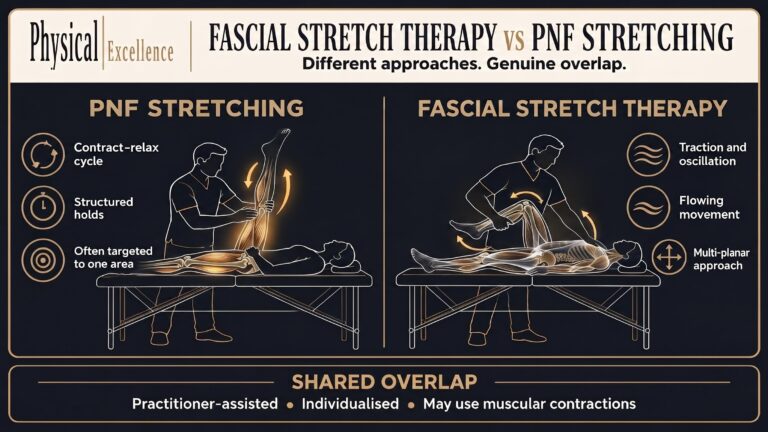
It is also worth checking that their training is relevant to the service being offered. “Stretching” can describe anything from a group mobility class to specialist assisted stretch therapy.
2. Is the provider appropriately insured?
Any practitioner delivering a hands-on workplace service should hold appropriate insurance for the work they provide.
Ask what cover they hold and whether they can provide evidence if required.
It is a straightforward check and one that should form part of choosing any workplace wellbeing provider.
3. Are sessions private and voluntary?
Assisted stretch therapy is hands-on and one-to-one.
Employees should understand what the session involves, have the opportunity to communicate any relevant information to the practitioner and always choose whether they wish to participate.
They should also be able to stop a session at any point.
Sessions should take place somewhere private. For most workplaces, a meeting room or quiet private space is sufficient.
4. How is employee information handled?
This is particularly important with any service where employees may share health information.
Health information can require additional protection, so organisations should understand what information is collected, why it is needed and who will have access to it.
For a workplace assisted stretch therapy service, HR doesn’t need detailed information about individual employees simply to understand whether the programme was well received.
Anonymous, combined feedback can provide useful insight without unnecessarily sharing individual employee information.
5. How much does HR need to organise?
A workplace wellbeing initiative can quickly become unattractive if it creates unnecessary administration.
- What space is required?
- Who provides the equipment?
- Who handles set-up and pack-down?
- How long are appointments?
- How will employees access their sessions?
- Who is the point of contact on the day?
A well-designed workplace stretch therapy service should require relatively little from the organisation.
At Physical Excellence, we bring the necessary equipment and handle set-up and pack-down. The workplace simply provides a suitable private room.
6. Will it fit around the working day?
A workplace wellbeing service should complement the working day rather than dominate it.
Ask how long appointments last, how changeovers are managed and approximately how many employees can be seen during a visit.
Our on-site assisted stretch therapy format typically uses private 30-minute appointments with short changeovers, allowing sessions to run throughout the day with minimal disruption.
7. Can you trial the service first?
When introducing something new, there is a simple question:
Will employees actually value it?
A pilot gives an organisation an opportunity to find out before considering a longer-term programme.
Physical Excellence offers London workplaces a complimentary half-day pilot, typically providing around six private 30-minute appointments across approximately four hours.
8. Are the practical terms clear?
Before beginning an ongoing programme, make sure both sides understand the practical arrangements.
That includes what is provided, scheduling, invoicing, any minimum commitment and what happens if a visit needs to be changed or cancelled.
Clear expectations make the programme easier for everyone to manage.
Red Flags to Look Out For
- Makes promises to diagnose or treat medical conditions outside their professional scope.
- Cannot clearly explain their qualifications or insurance.
- Is vague about who will deliver the sessions.
- Requests employee information without explaining why it is needed.
- Cannot clearly explain how the service will work within your workplace.
The HR Checklist
- A suitably qualified practitioner
- Appropriate insurance
- Private and voluntary one-to-one sessions
- Appropriate handling of employee information
- Clear space, equipment and set-up requirements
- Minimal disruption to the working day
- An opportunity to trial the service
- Clear practical and commercial arrangements
Keeping Workplace Wellbeing Simple
A good workplace wellbeing service should be straightforward for HR to organise and easy for employees to access.
For organisations exploring assisted stretch therapy in London, those principles provide a useful starting point when comparing providers.
If you’d like to see how this would work for your workplace, or to arrange a complimentary half-day pilot, I’d be happy to discuss. Get in touch.
Ebou Njie Founder, Physical Excellence
Specialist Assisted Stretch Therapy & Private Training | London
This article is for general information only and isn’t medical advice. Anyone with an injury, medical condition or pregnancy should speak to a GP or qualified healthcare professional before starting any new physical therapy.