What Desk Work Costs Your Team
For most office-based teams, the working day is a seated one. Meetings, screens, calls and
emails mean many employees spend the majority of their day at a desk, often without
standing for more than a few minutes at a time. It feels harmless enough. Yet the cost is real
—it simply doesn’t always appear on a balance sheet.
Across London’s business districts—from the City and Canary Wharf to Mayfair,
Knightsbridge, Chelsea and Kensington—thousands of professionals spend most of their
working day at a desk. Businesses invest heavily in technology, training and attracting
talented people. Yet one of the biggest factors affecting day-to-day comfort, focus and
productivity often goes unnoticed: prolonged sitting. Whether you’re leading a financial firm
in Canary Wharf, managing a legal practice in the City, overseeing a luxury hotel in
Knightsbridge or running a growing business in Chelsea, the physical demands of deskbased work are remarkably similar.
What sitting does to the body
Prolonged sitting gradually changes how the body moves. The hips become tighter, the
glutes become less active, and the back, shoulders and neck begin carrying more strain
than they were designed to. Over time, even the fascia—the connective tissue that links
muscles and joints throughout the body—adapts to the seated position.
We explore these physical changes in much more detail in our article, What Sitting All Day
Does to Your Body.
For employers, however, the more important question isn’t what happens to one individual.
It’s what those same changes, repeated across an entire workforce, quietly add up to over
months and years.
The cost that doesn’t show up
Physical discomfort quietly reduces productivity long before it becomes a complaint.
Someone with a stiff back, aching shoulders or restricted hips is still sitting at their desk and
still working—but rarely at their very best. They shift in their chair, lose concentration, take
longer over tasks and carry a level of physical tension that gradually chips away at focus
throughout the day. None of it is dramatic enough to mention, which is exactly why it often
goes unaddressed.
According to the UK’s Health and Safety Executive (HSE), musculoskeletal disorders remain
one of the leading causes of work-related ill health and sickness absence. While prolonged
sitting isn’t the only cause, it’s a significant contributor for many desk-based employees.
The cost appears as reduced comfort, lost working days and a workforce operating below
its full potential—none of it itemised, all of it real.
Why it’s so easy to miss
The challenge is that it develops gradually. No one points to a single day’s sitting as the
cause because no single day is. The effects accumulate over months and years until
stiffness, reduced mobility and physical discomfort simply become accepted as part of
working life.
Employees adapt.
Managers rarely notice.
The organisation absorbs the cost without ever seeing a report that identifies the problem.
What actually helps
Some solutions are simple and cost nothing. Encouraging office workers to stand regularly,
walk between meetings and break up long periods of sitting genuinely helps. Creating a
culture where movement is normal rather than exceptional is an excellent place to start.
However, for many desk-based professionals whose bodies have adapted to years of
prolonged sitting, reminders alone are often not enough. Once movement restrictions and
tension have become established, they usually require a more targeted approach to restore
comfortable movement.
Bringing it on-site
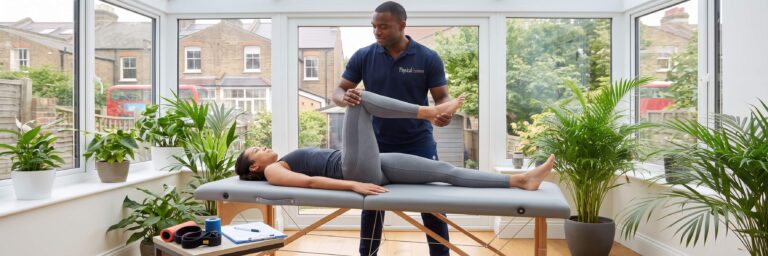
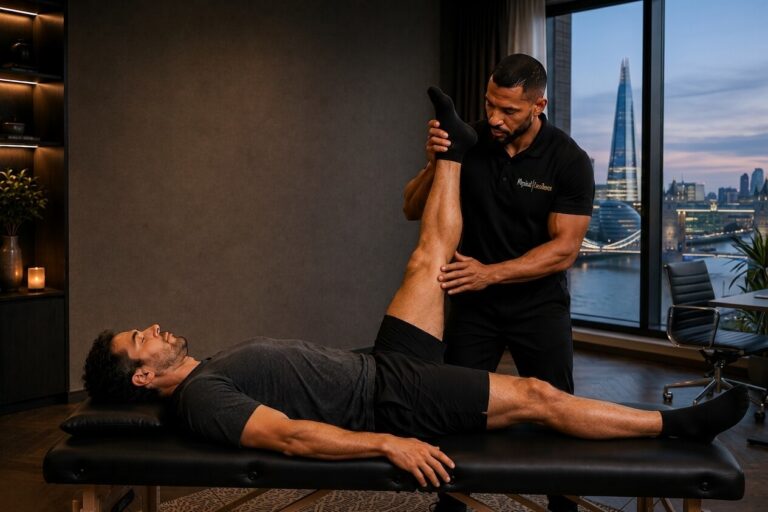
Assisted Stretch Therapy (Fascial Stretch Therapy, or FST) is a fully clothed, table-based
treatment where each employee is guided through gentle, assisted movements designed to
improve mobility, reduce accumulated tension and restore natural movement.
Sessions are delivered individually at your workplace, allowing employees to return to work
immediately afterwards without changing clothes or leaving the building. It’s a practical
wellbeing benefit that staff genuinely feel after their very first session—one that
demonstrates a meaningful investment in employee health, comfort, wellbeing and longterm productivity.
Unlike many workplace wellbeing initiatives that rely on participation outside working hours,
on-site Assisted Stretch Therapy meets employees where they already are, making it
simple, accessible and easy to engage with.
Whether you’re a business in Canary Wharf, the City, Mayfair, Knightsbridge or elsewhere in
London, sessions can be delivered around your working day with minimal disruption, making
it easy to integrate into your existing wellbeing programme.
Looking after employee wellbeing isn’t simply about reducing discomfort. It also contributes
to creating a workplace where people feel valued and supported, helping improve staff
retention over time while encouraging a healthier, more engaged workforce.
A simple next step
The best way to understand whether Assisted Stretch Therapy is right for your organisation
is to experience it first-hand.
That’s why Physical Excellence offers a complimentary on-site pilot session, giving your
team the opportunity to experience the service before making any ongoing commitment.
Whether you’re looking to enhance your existing wellbeing programme or introduce
something genuinely different, we’ll tailor the service to suit your organisation, your people
and the way you work.
If you’d like to arrange a consultation or discuss a complimentary pilot session, we’d be
delighted to hear from you.
Healthy people move better. When employees move better, they often feel better,
think more clearly and perform at their best. Investing in movement is an investment
in your people.
Ebou Njie Founder, Physical Excellence
Specialist Assisted Stretch Therapy & Private Training | London
This article is for general information only and should not be considered medical advice.
Assisted Stretch Therapy is not a medical treatment. Individuals experiencing persistent
pain or diagnosed medical conditions should seek advice from an appropriate healthcare
professional.