You can deadlift twice your bodyweight.
You can’t touch your toes without bending your knees.
If that sounds familiar, you’re not alone, and you’re not doing anything wrong. It’s one of the most common contradictions in the gym, and almost nobody explains why it happens.
Here’s why.
Strength and mobility are not the same thing. Many people describe themselves as strong but stiff, and this is exactly why. If you’ve ever wondered how you can keep getting stronger while feeling tighter, the answer starts here. You can build enormous amounts of one while barely touching the other.
Why this happens
Muscles are remarkably good at adapting to whatever you consistently ask them to do.
If you spend years training in a limited range — squatting to the same depth, benching through the same arc, running with the same stride — your muscles and connective tissue get very efficient at exactly that range.
They don’t automatically get better at ranges you never ask them for.
This is partly a fascia story. Fascia, the connective tissue that wraps and links your muscles, adapts to habitual movement patterns. Train the same pattern for long enough and the tissue becomes efficient at that pattern specifically, not at movement in general.
So the hamstrings of someone who deadlifts heavily three times a week are extremely strong through a specific range. That doesn’t mean they’re long, supple, or capable of moving freely through a much bigger range, like the one needed to touch your toes with straight legs.
Strength is your muscles’ ability to produce force. Mobility is your joints’ ability to move freely through a range of motion, with control. They’re produced by different training stimuli, and one doesn’t create the other by accident.
You’ve probably seen this before
A few examples I see often:
- A powerlifter with an extremely strong lower back who struggles to tie their shoes without discomfort.
- A CrossFit athlete who can bench press well beyond bodyweight but can’t get their arms fully overhead without arching their back.
- A footballer with powerful, explosive legs who pulls a hamstring doing something far less demanding than a sprint — because the tissue was strong, but not resilient through a fuller range.
None of these people are unfit. Quite the opposite. But strength alone didn’t protect them, because it was never designed to.
What to do about it
The good news is this isn’t an either/or situation. You don’t need to choose between being strong and being mobile.
Most well-designed strength programmes already include some mobility work, but it’s often the first thing to get dropped when time is short. Ironically, that’s usually the piece that would have prevented the ache, tightness, or minor injury that later interrupts training altogether.
A few genuinely useful additions to almost any training programme:
- Training through a fuller range where it’s safe to do so, not just the range that feels easiest.
- Dedicated mobility or corrective work for the areas your main lifts don’t naturally address — hips and shoulders are the most common gaps.
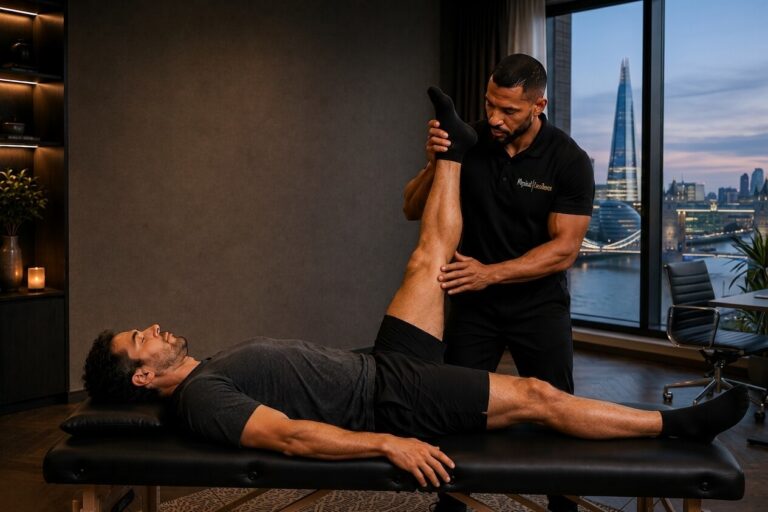
- Regular soft tissue work, whether that’s self-massage, foam rolling, or Assisted Stretch Therapy, to help the tissue adapt to a broader range rather than just a stronger one.
Don’t abandon strength training to chase mobility. The goal isn’t to choose one over the other — it’s to let each support the other.
The takeaway
Strength tells you how much force your body can produce.
Mobility tells you how freely your body can move.
If you’re training hard and still feel tight, restricted, or one injury away from a setback, it might not be a strength problem at all.
The strongest athletes don’t choose between strength and mobility — they develop both. That’s often what allows them to keep training consistently for years rather than months.
If you’d like to talk through how Assisted Stretch Therapy could complement your current training, I’d be happy to discuss whether it’s right for you.
Ebou Njie Founder, Physical Excellence
Specialist Assisted Stretch Therapy & Private Training | London
This article is for general information only and should not be considered medical advice. Assisted Stretch Therapy is not a medical treatment. Individuals experiencing persistent pain or diagnosed medical conditions should seek advice from an appropriate healthcare professional.