There is a physical cost to carrying a lot.
Most people notice it first in movement. Stiff hips. Tight shoulders. A back that feels less comfortable than it used to. Breathing that feels shallower. Energy that takes longer to recover.
These changes rarely happen overnight. They build gradually through demanding schedules, family responsibilities, long working hours, travel, stress, and the habit of placing recovery at the bottom of the priority list.
For many people living in Kensington, the body continues to cope long after it has stopped moving as freely as it once did.
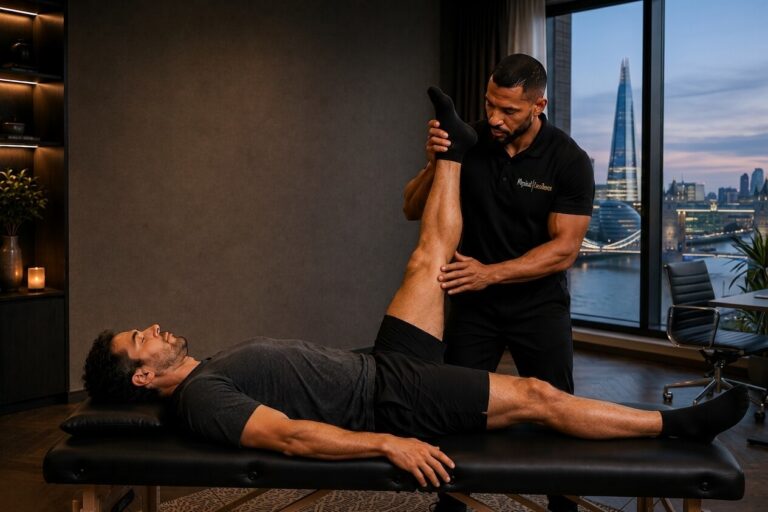
This article looks at what assisted-stretch-therapy involves, what it may offer for people living in Kensington and the surrounding areas, and three things you can try today to begin addressing tension that has built up over time.
The physical cost of carrying a lot
Kensington is home to people with very different lifestyles, but many share one thing in common: responsibility.
Some are running businesses. Some are managing demanding careers. Some are raising families. Some are caring for others. Others are balancing all of these at the same time.
The body does not distinguish between physical stress and mental stress. Both influence movement, breathing, recovery, and muscular tension.
Over time, the body adapts to this environment. Hip flexors shorten. The ribcage becomes less mobile. The upper back stiffens. The chest tightens. Recovery becomes less efficient. Movement gradually feels less effortless than it once did.
One thing that comes up consistently when working with clients in West and Central London is that people often cannot pinpoint when the stiffness began. It arrived so gradually that it became the new normal — and they only recognise how restricted they had become once movement starts to feel different again.
This is one reason why research into fascial tissue has become increasingly relevant to people living busy lives. The fascial system — the continuous connective tissue network that links muscles, joints and organs throughout the body — responds directly to sustained posture, movement habits and stress. Restrictions in this system can contribute to patterns of tension that stretching and massage alone do not fully address.
Three things to try today
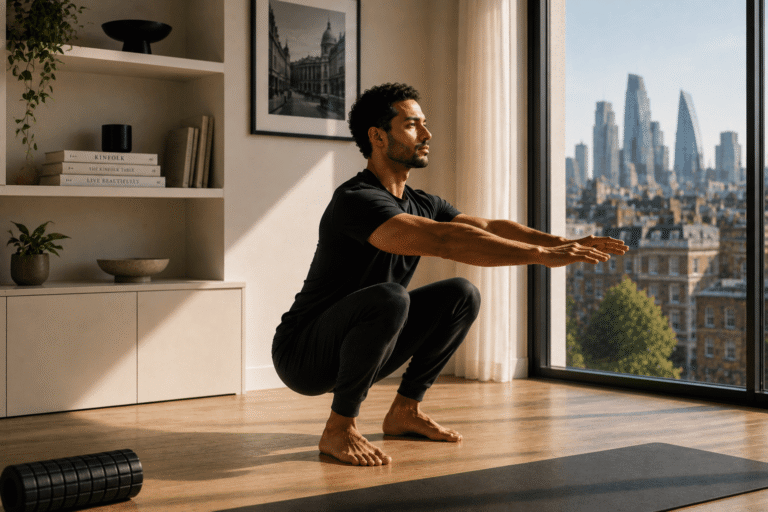
These are not exercises. They are simple observations and brief interventions that may give you useful information about where your body is holding tension right now. They take under five minutes in total.
- The seated hip flexor check.
Sit upright on the edge of a chair with both feet flat on the floor. Without leaning back, try to sit completely tall — spine long, shoulders relaxed, head level. For most people who sit for extended periods, this position feels effortful within 30 seconds. The hip flexors and lower back begin to pull. That pull is useful information — it tells you exactly where restriction has been built.
- The shoulder rotation test.
Stand with your arms by your sides. Without moving your lower body, rotate your upper body slowly to the right as far as feels comfortable. Note how far you can go. Then rotate to the left. Most people find a noticeable difference between sides — one direction feels more restricted than the other. That asymmetry often reflects a pattern of restriction that has developed over time from habitual posture or repetitive movement.
- The breathing depth test.
Sit or stand quietly. Take the deepest breath you can and notice where you feel the breath reaching. Does it expand your chest in all directions — front, back and sides? Or does it feel like it stops in the upper chest, with the lower ribcage barely moving? Restricted thoracic fascia and tight intercostal tissue can significantly limit breathing depth in people who sit for long periods. This is one of the most consistent patterns I see in clients who work in high-pressure environments.
Try all three and notice what comes up. If any of them reveal a pattern you recognise — that is worth exploring further.
One thing worth remembering
Most people do not notice restrictions while it is developing.
They notice it when everyday movements stop feeling as easy as they once did. A shoulder that feels tighter reaching overhead. A back that takes longer to loosen up in the morning. Hips that feel stiff after sitting. Breathing that feels shallower during periods of stress.
By that stage, the body has often been adapting for months or years.
The good news is that awareness is usually the first step. Once patterns of restriction are recognised, it becomes much easier to understand what may be contributing to them and what options are available to address them.
Mobile sessions in Kensington
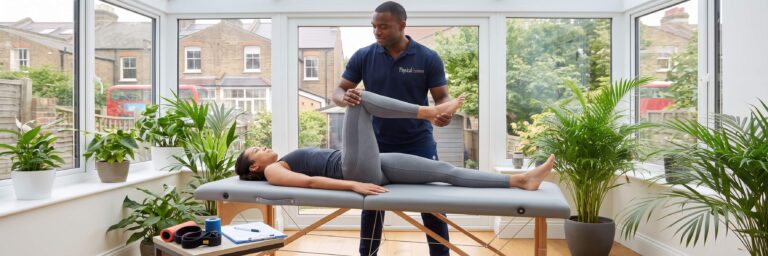
Sessions are delivered to your home, flat or residential building anywhere in Kensington, Holland Park, Notting Hill, Bayswater, South Kensington and throughout West London. A professional treatment table is set up in a room of your choosing — sessions run for 60 or 90 minutes and begin and end at your door.
For clients who prefer complete discretion — sessions are delivered privately, with no reception, no waiting room, and no contact with anyone other than the practitioner.
Tried any of the three tests above? If you noticed something worth exploring — drop a WhatsApp on 077 7007 2333. No obligation. Just a brief conversation about whether assisted stretch therapy might be relevant for you.
Common Questions
Very little. A clear space of approximately two metres by one metre is enough for the treatment table. You remain fully clothed throughout — comfortable, loose-fitting clothing works best, though anything that allows reasonable movement is fine. The session begins when you are ready and proceeds entirely at your pace.
Personal training focuses on conditioning, strength and fitness. Assisted stretch therapy focuses specifically on the connective tissue system — the fascial restrictions that affect how freely the body moves and how efficiently it recovers. The two serve different purposes and work well alongside each other. Many people who already train regularly find that addressing fascial restrictions improves both their performance and their recovery between sessions.
This depends entirely on the nature of the condition. Assisted stretch therapy is a wellbeing service and not a medical treatment — it is not appropriate for all conditions or at all stages of recovery. A complimentary consultation is the best starting point. It allows for a brief conversation about your history, what you are hoping to address, and whether this approach is likely to be suitable. If it is not, that will be said clearly.
A complimentary consultation is available for anyone in Kensington or the surrounding areas who would like to understand whether assisted stretch therapy may be relevant before booking a session. No pressure, no obligation — simply a conversation.
— Ebou Njie
Stretch Therapist · London
If you have questions or would like to arrange a complimentary consultation — get in touch.
hello@physical-excellence.com · 077 7007 2333
Assisted stretch therapy is a wellbeing service and is not a medical treatment. It is not intended to diagnose, treat, or cure any condition. Please consult your GP or a qualified healthcare professional if you have any health concerns before booking.