You’ve tried massage. You’ve tried yoga. The tension came back anyway. If that’s where you are right now — there may be a straightforward reason why, and it’s worth understanding before trying anything else.
This article explains what assisted stretch therapy is, how it works, and what to expect if you’re considering it in Chelsea or the surrounding areas.
Why some tension is harder to shift
Tension does not always stay where it starts. Tight shoulders don’t always begin at the shoulders. Lower back discomfort doesn’t always start in the lower back. The body works as a connected system — and that’s one reason the same area can keep returning to tightness despite repeated treatment.
One thing that comes up regularly when working with clients is that people often assume tightness sits where discomfort shows up — but restrictions can sometimes appear elsewhere and refer tension to a completely different area.
Growing research into fascial tissue — the connective network that links muscles, joints, and organs throughout the body — suggests it may play a significant role in how restrictions accumulate over time. When one part of this system becomes restricted, the effects can travel. A tight hip can contribute to lower back discomfort. Restriction in the chest can affect how the shoulders move. This is one reason why treating a single area in isolation can bring only temporary relief.
For people living and working across Chelsea, Fulham, Kensington and South Kensington — long hours at a desk, commuting into the City, frequent travel, training hard, or simply carrying the demands of a busy lifestyle — these patterns can build quietly over time until movement no longer feels as comfortable as it once did.
What assisted stretch therapy involves
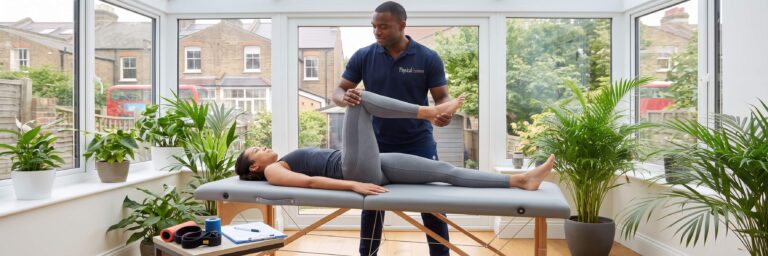
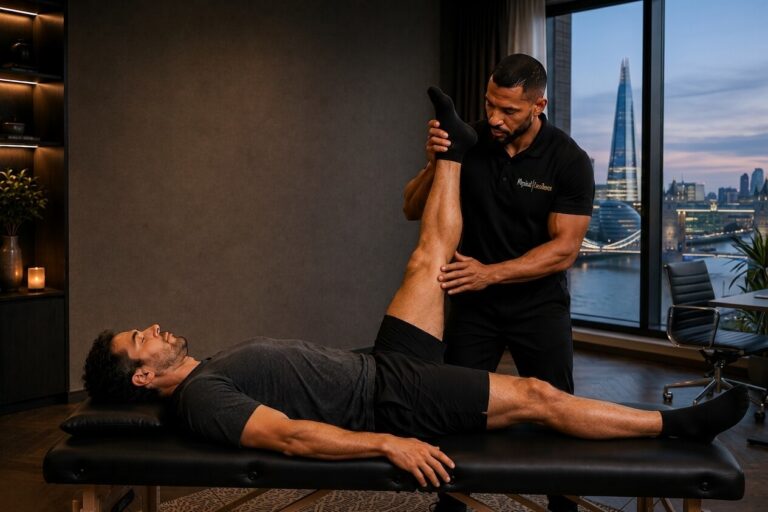
Assisted stretch therapy — specifically a method called Fascial Stretch Therapy, or FST — is a table-based treatment that works with the body’s connective tissue system rather than individual muscles alone.
You lie fully clothed on a treatment table. The therapist guides your body through a series of slow, assisted movements — working with your nervous system rather than against it. There is no forcing, no pain, and no requirement for you to do anything actively. The approach takes a different view from static stretching by looking at how movement restrictions may be influencing surrounding areas — not just where tightness is felt.
For a full explanation of what happens during a session, visit the Assisted Stretch Therapy page.
Who assisted stretch therapy may suit
This may be relevant if you are:
- A desk worker sitting for long periods
- Someone commuting or travelling frequently
- A parent carrying children regularly
- An active adult — runner, cyclist, gym-goer — wanting better movement or recovery
- Someone who has tried other approaches without lasting relief
- Anyone who simply wants to feel less restricted day to day
It is not a medical treatment and is not a substitute for medical advice. If you have a diagnosed condition or are recovering from injury, speak to your GP before booking.
Three things worth noticing about your body today
These aren’t exercises — they’re observations. They won’t replace a proper assessment, but they may give you a clearer sense of where tension is sitting right now.
Try these today:
Lie flat on a hard floor for two minutes.
Notice where your body doesn’t make full contact with the ground. Gaps under the lower back, one shoulder sitting higher than the other, or tension in the neck are all worth paying attention to.
Take three slow, deep breaths and notice where you feel resistance.
Shallow breathing is often associated with tension held in the chest and ribcage — areas that can quietly restrict movement over time.
After sitting for an hour, stand and let your upper body hang forward gently.
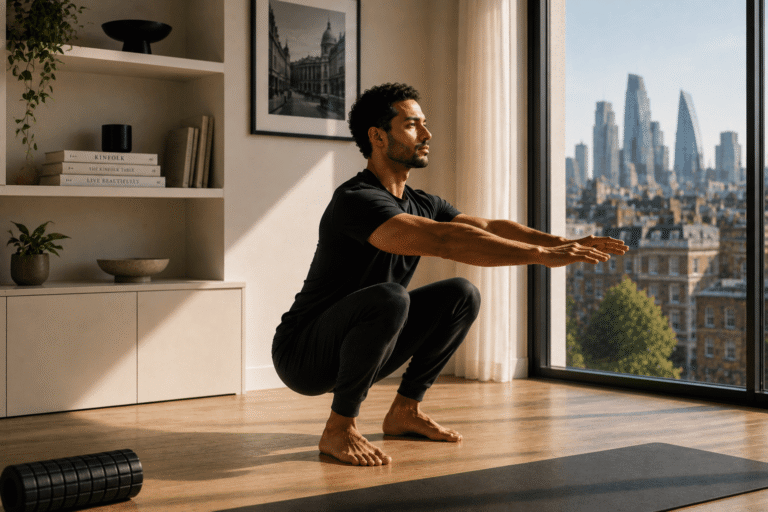
Don’t force it. Let gravity do the work for thirty seconds. Notice where you feel the pull — that’s often where restriction is most present.
Mobile sessions in Chelsea
Sessions are delivered at your home or building — anywhere in Chelsea, Fulham, South Kensington, Kensington, or the surrounding areas of West London. There is no need to travel to a clinic. A professional treatment table is brought to you, and sessions are available in 60 or 90 minutes.
Home stretch therapy in Chelsea means your body stays in a calm, familiar environment throughout — which many people find helps them get more from the session.
Common Questions
It shouldn’t be. FST is designed to work with the body rather than force it. Some areas holding more tension may feel more intense when worked through — but comfort levels are always respected and the pace is guided by how your body responds.
This varies considerably from person to person — depending on how long restrictions have been building, lifestyle, movement habits, and stress levels. Some people notice a difference after one session. Others benefit from a course of sessions over several weeks. This is worth discussing during the consultation.
Many people working at desks seek assisted stretch therapy specifically for neck, shoulder, and lower back tension. Whether it helps — and how much — depends on the individual. Results are not guaranteed and vary from person to person.
A complimentary consultation is available for anyone wanting to understand whether assisted stretch therapy may be suitable before booking. The goal is simply to help you understand whether it feels like the right fit — with no pressure and no obligation.
— Ebou Njie
Stretch Therapist · London
If you have questions or would like to arrange a complimentary consultation — get in touch.
hello@physical-excellence.com · 077 7007 2333
Assisted stretch therapy is a wellbeing service and is not a medical treatment. It is not intended to diagnose, treat, or cure any condition. Please consult your GP or a qualified healthcare professional if you have any health concerns before booking.