Stretch Therapy and Recovery: What Training Alone Misses
You train consistently. You turn up, put the work in, follow the programme—and yet things have flattened out. The numbers aren’t moving, sessions feel harder than they should, and you’re carrying a stiffness that never quite clears.
The instinct is usually to train more or train harder.
Often, that’s the wrong instinct.
The ceiling isn’t always your effort.
It’s your recovery.
Across London, from Chelsea and Kensington to Knightsbridge, Mayfair and the City, I regularly see this pattern in people who train consistently. Whether they lift weights, run, cycle, practise martial arts or simply enjoy staying active, many assume they need to work harder when, in reality, they often need to recover better.
The session is the stimulus, not the result
Training doesn’t build the body.
It challenges it.
Every workout creates a stimulus, asking your body to become stronger, fitter or more resilient. The actual adaptation happens afterwards while you recover.
Sleep.
Nutrition.
Hydration.
Stress management.
Recovery is where your body responds to the work you’ve asked it to do.
It’s why two people can follow exactly the same programme and achieve very different results. The training may be identical, but the quality of their recovery often isn’t.
The debt that builds across a training block
Recovery isn’t something that starts and finishes after a single workout.
It accumulates.
Every hard session leaves behind a little fatigue and a little physical tension. When recovery is sufficient, you begin your next session feeling fresh and ready to perform.
When it isn’t, you begin slightly behind.
A little tighter.
A little heavier.
A little more fatigued.
Over several weeks those small deficits become noticeable. Progress slows, movement becomes less comfortable and sessions begin feeling harder despite putting in the same effort.
Many people respond by training harder.
Often that’s exactly the opposite of what the body needs.
Recovery isn’t only about energy
Recovery isn’t just about restoring energy.
It’s also about restoring movement.
Hard training naturally creates muscular tension. If that tension gradually accumulates over weeks or months, movement often becomes less efficient, range of motion decreases and areas of the body begin compensating for one another.
The result isn’t always injury.
More often it’s simply a body that feels heavier, stiffer and less prepared for the next session than it could be. (Mobility also feeds performance in its own right — something we cover separately.)
Where Assisted Stretch Therapy fits
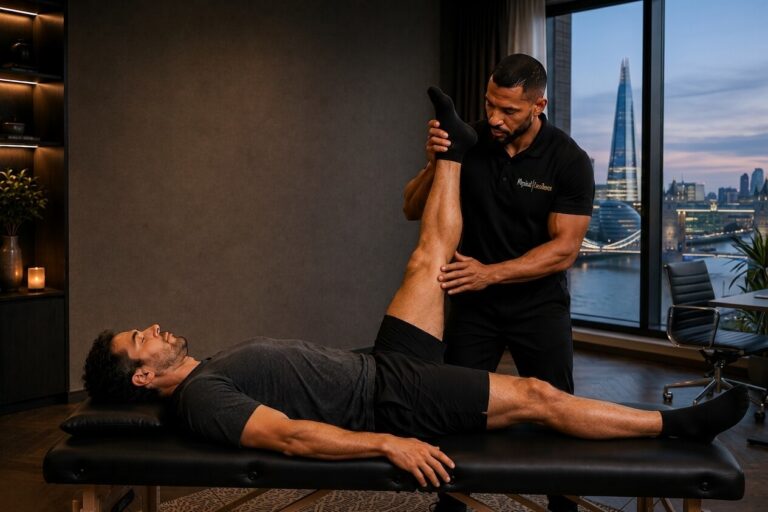
This is where Assisted Stretch Therapy earns its place—not as a replacement for good recovery habits, but as another tool that supports them.
Sessions are slow, gentle and fully assisted. You remain fully clothed while your body is guided through comfortable movements designed to improve mobility, reduce accumulated physical tension and help restore comfortable movement.
The goal isn’t to push your flexibility.
It’s to help your body recover more effectively between training sessions.
Sleep, nutrition, hydration and sensible programming will always remain the foundations of recovery.
Assisted Stretch Therapy complements those foundations by addressing something many active people overlook—the gradual build-up of physical tension that can quietly reduce movement quality over time.
You don’t need to be an athlete
One of the biggest misconceptions about recovery is that it only matters if you compete.
It doesn’t.
Anyone who trains consistently—whether that’s strength training, running, cycling, martial arts, recreational sport or simply exercising several times each week—places physical demands on their body.
The better you recover, the better prepared your body is for the next challenge.
Four recovery habits worth prioritising
Recovery doesn’t need to be complicated. Consistently focusing on a few key habits often makes the biggest difference.
- Aim for seven to nine hours of quality sleep whenever possible.
- Eat enough protein and carbohydrates to support recovery after harder training sessions.
- Include lighter recovery days within your training programme instead of pushing hard every day.
- Address accumulated physical tension before it begins affecting how comfortably you move.
A final thought
Recovery isn’t the empty space between workouts.
It’s where your training becomes progress.
If your performance has plateaued despite training consistently, it may be worth looking beyond the programme itself. Sometimes the biggest improvements don’t come from adding more work—they come from allowing your body to recover more effectively from the work you’re already doing.
If you’d like to explore whether Assisted Stretch Therapy could become part of your recovery strategy, I’d be happy to discuss how it could support your goals and tailor each session to the way you move and train.
Ebou Njie Founder, Physical Excellence
Specialist Assisted Stretch Therapy & Private Training | London
This article is for general information only and should not be considered medical advice. Assisted Stretch Therapy is not a medical treatment. Individuals experiencing persistent pain or diagnosed medical conditions should seek advice from an appropriate healthcare professional.