Why Your Lower Back Keeps Feeling Tight
Of all the places the body holds tension, the lower back is one of the most stubborn. It eases for a day, then returns — often with no obvious trigger. The reason it keeps coming back usually has less to do with the back itself than most people expect.
Why it keeps returning
Lower back tightness can come from several places — the core, long hours in a static posture, sometimes the back itself. But very often the real cause sits below it, in the lower body: the hips, quads, hamstrings and glutes.
The lower back is frequently the victim of what’s happening underneath it. Tight hip flexors tip the pelvis forward. Tight hamstrings pull it the other way. Stiff quads feed into restricted hips. And glutes that have switched off leave the back to pick up work that isn’t really its own. Different cause, same result — a lower back that tightens because the muscles around and below it aren’t doing their share.
That’s why stretching the back directly only ever helps for a day or two. The back loosens, but the lower body that caused the strain hasn’t changed, so the tightness comes straight back.
After more than twenty years working with how people move, the pattern I see most often with a stubborn lower back is a simple one: the people who struggle with it are very often the ones with the least movement through their lower body. Free up the hips, hamstrings and glutes, and the back usually follows.
Three things to notice
These quick checks may show you where in the lower body your tightness is really coming from. They take a few minutes.
- The hip-flexor check. Lie on your back and draw one knee gently towards your chest. If the opposite thigh lifts off the floor, or the front of that hip feels tight, the hip flexors have likely shortened — a common way the pelvis gets pulled out of position.
- The hamstring check. Sit on the floor with your legs straight out in front and reach gently towards your toes. If you can’t get far before the lower back rounds or your knees want to bend, tight hamstrings may be tugging on the pelvis from behind.
- The glute squeeze. Standing, try to squeeze one glute at a time. If one side is harder to switch on, that weakness may be quietly leaving your lower back to do its job.
Three things that may help
If those checks rang true, here are three gentle things to try — one for each of the main lower-body culprits. None should hurt; ease off if anything sharpens.
- Kneeling hip-flexor stretch. From a half-kneeling position (one knee down, other foot forward), tuck your pelvis under slightly and shift your weight gently forward until you feel a stretch at the front of the kneeling hip. Hold 30–60 seconds each side. This eases the hip flexors that tip the pelvis forward.
- Seated hamstring release. Sit tall on the edge of a chair, straighten one leg with the heel on the floor and toes up, and hinge forward gently from the hips until you feel a stretch up the back of the thigh. Hold 30 seconds each side. This frees the hamstrings that pull the pelvis from behind.
- Glute bridge. Lie on your back, knees bent, feet flat. Press through your heels and lift your hips, squeezing the glutes at the top, then lower slowly. Repeat 8–10 times. This wakes up glutes that have switched off, so they share the load instead of leaving it all to your back.
When self-help isn’t enough
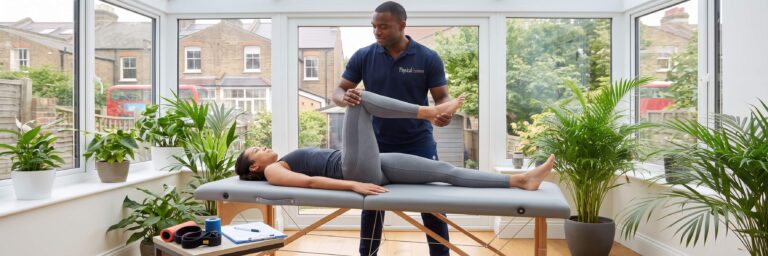
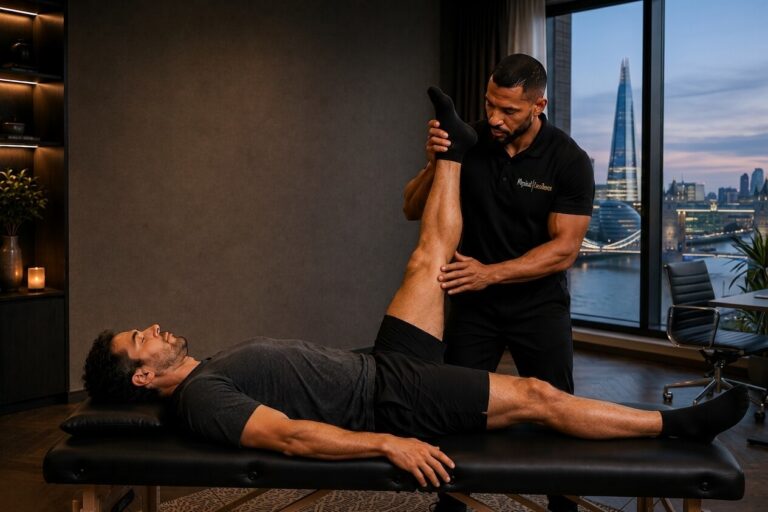
These can take the edge off, but if the pattern has built over years, it often needs more than you can reach on your own. Assisted stretch therapy — Fascial Stretch Therapy, or FST — is a table-based treatment where you lie fully clothed and the therapist guides your body through slow, assisted movements, working through the lower body — hips, quads, hamstrings and glutes — that tends to drive lower back tightness. There’s no forcing and no pain. You can read more on the Assisted Stretch Therapy page.
Sessions are mobile and come to you — at home or at your workplace — across London, including Chelsea, Kensington, Knightsbridge, Mayfair and the City.
Common Questions
It may ease things briefly, but if the cause sits in the lower body — the hips, hamstrings or glutes — the tightness usually returns. Working the whole pattern lasts longer.
The stretches above are gentle and shouldn’t hurt — ease off if they do. If you have a diagnosed condition, check with your GP first.
Many people feel freer quite quickly, though lasting change comes from staying consistent over several weeks.
If your lower back tightness keeps returning whatever you try, it may be worth looking at the whole picture rather than the sore spot. I offer a complimentary consultation — a relaxed conversation to look at how you’re moving and talk through whether stretch therapy could help. No obligation, just a clearer sense of what’s going on.
— Ebou Njie
Stretch Therapist · London
If you have questions or would like to arrange a complimentary consultation — get in touch.